
ARM Processors, originally designed in the United Kingdom as ARM1, have revolutionized mobile technology. The ARM-powered Nokia 6110 GSM mobile phone marked a major milestone, with the ARM7 processor becoming a flagship mobile design. Today, over 99% of the world’s smartphones run on ARM technology
ARM Diversifies Its Product Line into Three Major Categories
1.Cortex-A
2.Cortex-R
3.Cortex-M
In short ARM 🙂
Cortex-A
“A-Series Processors: High-Performance Solutions for Applications and Complex Operating Systems”
The “A” in ARM’s A-Series stands for Application, indicating that these processors are designed for application-oriented purposes. They are primarily used to deliver high performance and support complex operating systems, including Windows and Linux.
Cortex-R
“R-Series Processors: Real-Time Performance for Network Devices and Embedded Systems”
The “R” in ARM’s Cortex-R series stands for Real-Time, tailored for systems that need precise, time-sensitive operations. These processors are commonly used in network devices and embedded control systems, ensuring reliable and fast performance.
Cortex-M
“M-Series Processors: Power-Efficient Microcontrollers for IoT Devices and Sensors”
The “M” in ARM’s Cortex-M series stands for Microcontroller, designed for small, power-efficient applications. These processors are ideal for IoT devices and sensors, where energy conservation and compact size are critical.
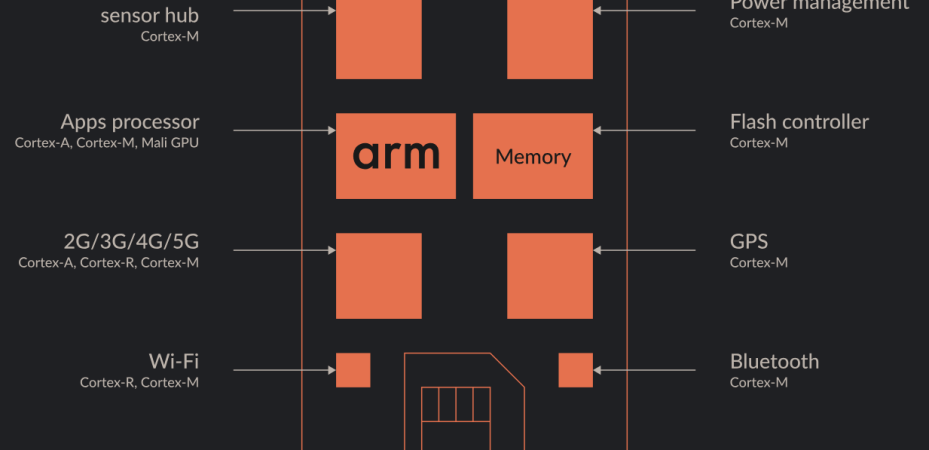
See below image the level of processor used in a mobile device

What is Architecture
Architecture Means functional specification and it specify How a process will behave. Example What are the instruction and what will it do.
The architecture specification defines key elements. These include the instruction set, registers, exception model, memory management, and debug tracing and profiling. These specifications give the foundation for developing both hardware and software.
System architecture, on the other hand, refers to systems with multiple processor cores, enabling advanced performance and efficiency.
Architecture vs Micro Architecture
Architecture defines the instruction set and the corresponding actions. Micro-architecture focuses on the internal structure and operation of the processor. It encompasses elements like:
- Pipeline Design
- Execution Units
- Cache Hierarchy
- Branch Prediction
- Data Paths
These components are crucial for determining how efficiently a processor executes instructions and performs tasks.
For instance, both the Cortex-A53 and Cortex-A72 are implementations of the Cortex-A architecture, yet they feature distinct micro-architectures. Key differences include the size of the L1 Cache, D-Cache, Crypto Extension, L2 Cache, and AMBA (Advanced Microcontroller Bus Architecture). These variations significantly impact performance and efficiency in processing tasks.
Bonus
ARM frequently publishes annual updates that introduce new instructions and features. For example, when ARMv9.0 is released, it inherits all features from ARMv8.0. Following the initial launch of ARMv9.0, both versions are updated simultaneously. Any new features introduced in ARMv9.0 are also updated and maintained in ARMv8.0, ensuring consistency and enhanced functionality across versions.


 ErrBits
Leave a comment